CTF: First Blood
No hand-holding this time. Decode, decrypt, and think like an attacker to recover the flags. Bring what you learned in the earlier rooms.
What Is a CTF?
Games that teach you to hack
A CTF — Capture The Flag — is a hacking game. You are given challenges, and hidden inside each is a secret string called a flag. Find the flag, submit it, earn points. That is the whole loop, and it is how most people fall in love with security.
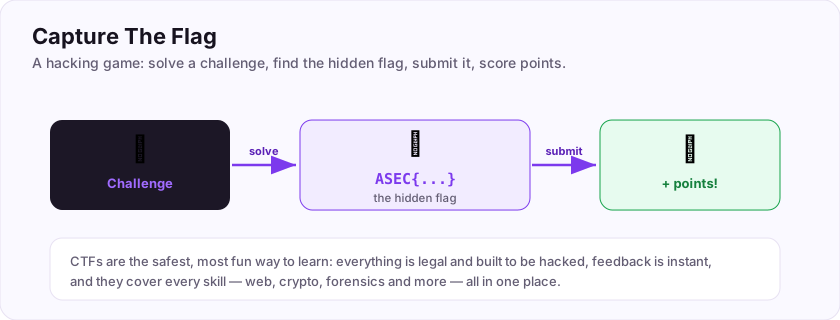
CTFs are the safest, most fun way to learn, because:
- Everything is legal and built to be hacked — no permission worries.
- You get instant feedback — the flag is either right or wrong.
- They cover every skill at once — web, crypto, forensics, and more.
This room is your first proper challenge box. The earlier rooms taught you ideas; here you *use* them to recover real flags.
Flag: ASEC{capture_the_flag}
In a CTF, what do we call the secret string you must find to prove you solved a challenge? (one word)
+10 ptsNeed a hint?
It is in the name: Capture The ___.What is the flag for this task?
+10 ptsNeed a hint?
It is in bold at the end.The Flag Format and Mindset
Know what you are looking for
Before hunting, know your prey. On this platform every flag follows the same shape: a prefix, then curly braces around some text.
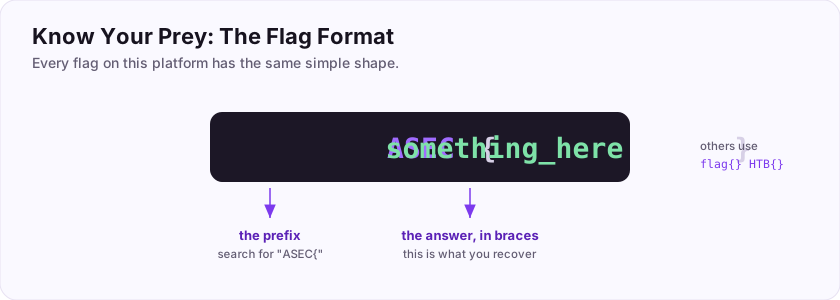
ASEC{something_here}The prefix here is ASEC, and the answer sits inside the { }. Different competitions use different prefixes (flag{}, HTB{}, picoCTF{}), but the idea is identical. Knowing the format is powerful: you can literally search a page, a file, or decoded text for ASEC{ to find flags fast.
The mindset
- Do not overcomplicate. The simplest thing that could work usually does.
- Look everywhere. Page source, comments, response headers, file contents.
- Notice odd data. Strange strings are begging to be decoded.
ASEC{ — it is the fastest way to spot one.Flag: ASEC{read_the_format}
This platform's flags all start with which four-letter prefix?
+10 ptsNeed a hint?
Look at any flag on the site.What is the flag for this task?
+10 ptsNeed a hint?
It is in bold at the end.Recognising Encodings
Learn to spot scrambled data at a glance
Half of beginner CTF challenges are just data in disguise. The skill is recognising which disguise it is, so you know how to reverse it.
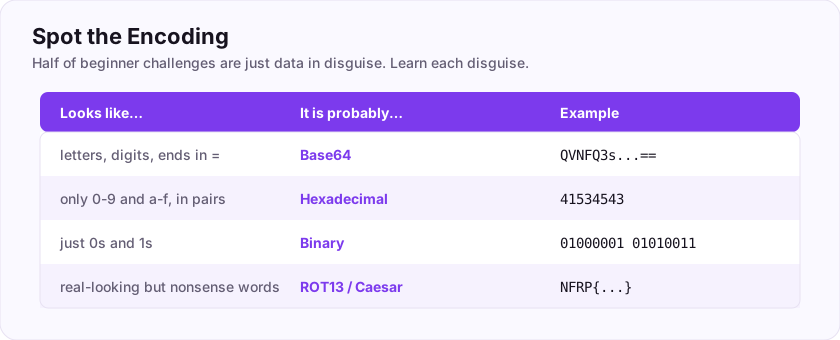
A quick field guide:
- Base64 — letters, digits,
+and/, usually ending in one or two=signs. So a string ending in=is probably Base64. - Hexadecimal — only the characters
0-9anda-f, often in pairs, like41534543. - Binary — just
0s and1s in groups of eight. - ROT13 / Caesar — looks like normal words but nonsense, e.g.
NFRP.
Remember the crucial point from the crypto room: encoding is not encryption. It needs no key, so anyone can reverse it. Recognising it is most of the battle.
= is almost always Base64. Learn the tell-tale signs of each encoding.Flag: ASEC{spot_the_encoding}
A string of letters and digits ending in one or two = signs is probably which encoding?
+10 ptsNeed a hint?
The == padding gives it away.What is the flag for this task?
+10 ptsNeed a hint?
It is in bold at the end.Encoding is not encryption
Your first flag: decode the Base64
You intercept this string in a request:
QVNFQ3tiYXNlNjRfaXNfbm90X2Ffc2VjcmV0fQ==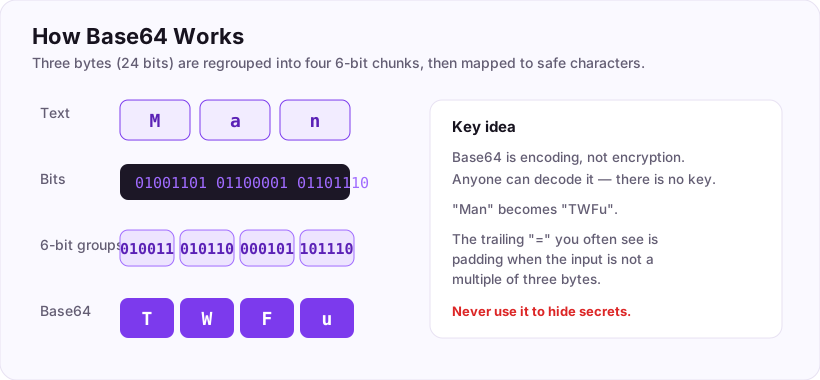
It is not encrypted — it is Base64 encoded, which anyone can reverse. Notice the tell-tale == at the end. Decode it to recover the flag:
$ echo QVNFQ3tiYXNlNjRfaXNfbm90X2Ffc2VjcmV0fQ== | base64 -d
ASEC{base64_is_not_a_secret}
Any online Base64 decoder (or CyberChef) works just as well. This is one of the most common moves in all of CTF — see a suspicious string, decode it first.
== padding gives it away as Base64. Decode it with base64 -d, CyberChef, or any online tool.Decode the Base64 string to recover the flag.
+30 ptsNeed a hint?
Base64 strings often end in one or two equals signs.Caesar would be proud
A 2000-year-old cipher you can break in your head
The next flag is hidden with ROT13, a simple Caesar cipher that shifts every letter 13 places along the alphabet.
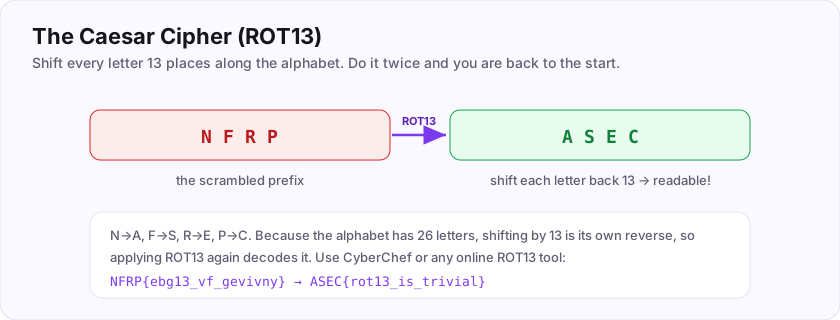
NFRP{ebg13_vf_gevivny}Because the alphabet has 26 letters, shifting by 13 twice brings you back to the start — so ROT13 is its own inverse. Apply ROT13 again to reverse it:
N → A, F → S, R → E, P → C ...
NFRP{ebg13_vf_gevivny}  →  ASEC{rot13_is_trivial}
You can use an online ROT13 tool, CyberChef, or the "ROT13" option in most decoder sites. The name of the flag says it all — this cipher is trivial, which is exactly why it shows up in beginner CTFs.
NFRP is ROT13 for ASEC.Reverse the ROT13 text to recover the flag.
+30 ptsNeed a hint?
ROT13 is its own inverse, apply it again.Common CTF Categories
The kinds of challenges you will meet
CTF challenges are sorted into categories, and knowing them tells you which skills to reach for.
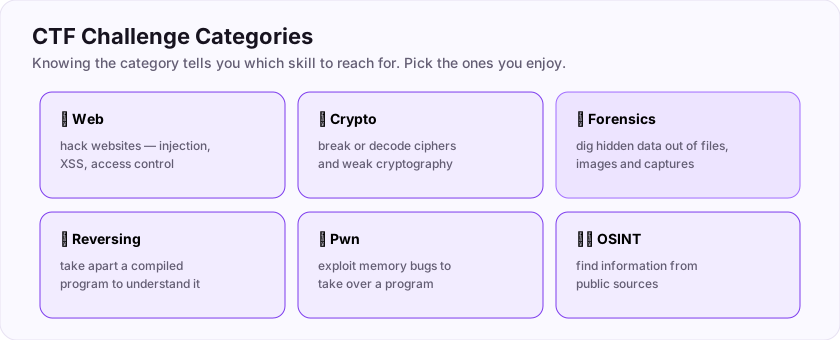
- Web — hack websites (the injection, XSS, and access-control skills from your web rooms).
- Crypto — break or decode ciphers and weak cryptography.
- Forensics — dig hidden data out of files, images, network captures, and memory dumps.
- Reversing — take apart a compiled program to understand or defeat it.
- Pwn (binary exploitation) — exploit memory bugs to take control of a program.
- OSINT — find information from public sources.
You do not need to master all of them. Most people find one or two they love and go deep. The category that hunts hidden data inside files and images is forensics.
Flag: ASEC{know_your_categories}
Which CTF category is about digging hidden data out of files, images and memory? (one word)
+10 ptsNeed a hint?
Like a detective examining evidence.What is the flag for this task?
+10 ptsNeed a hint?
It is in bold at the end.A Solver's Toolkit and Method
Tools and a plan for when you are stuck
You do not need many tools to start, but a few are magic.
- CyberChef — a free web app nicknamed "the cyber swiss army knife". Paste in mystery data and it can detect and decode Base64, hex, ROT13, and hundreds more, often automatically. It is a CTF beginner's best friend.
- The browser Dev Tools for web challenges.
- A Linux terminal for
base64 -d,strings,grep, and friends.
When you get stuck
- Re-read the challenge title and text — they are usually hints.
- Look at the data again: what encoding could it be?
- Try the obvious tool — decode it, run
stringson it, view the source. - Take a break — fresh eyes solve challenges.
Flag: ASEC{cyberchef_is_magic}
Which popular free web app is nicknamed the "cyber swiss army knife" for decoding data?
+10 ptsNeed a hint?
One word, capital C and C.What is the flag for this task?
+10 ptsNeed a hint?
It is in bold at the end.Putting It All Together: First Blood
Go get first blood
"First blood" is the CTF term for being the first person to solve a challenge — a small, addictive thrill. You now have what you need to earn it.
Your first-blood checklist:
- Know the flag format (
ASEC{...}) and search everything for it. - Recognise encodings —
=means Base64, nonsense words mean ROT13,0-9a-fmeans hex. - Reverse them with
base64 -d, ROT13, or CyberChef. - Match the challenge to a category and reach for the right skill.
- When stuck, re-read the hint, try the obvious tool, and rest.
That loop — recognise, decode, submit — will carry you through hundreds of beginner challenges. The rooms ahead go deeper into each category, but the CTF mindset you built here never changes.
Your graduation flag for this room: ASEC{you_got_first_blood}
Being the first to solve a challenge is famously called "first ___"? (one word)
+10 ptsNeed a hint?
It is in this room's title.What is your graduation flag for this room?
+15 ptsNeed a hint?
It is in bold at the very end.Deep Dive & Field Practice
A repeatable method beats luck
The players who get first blood are not lucky — they are systematic. Enumerate thoroughly before you exploit anything: every open port, every web directory, every service version, every hint in the source.
Ninety percent of stuck moments are solved by going back and enumerating harder, not by trying a flashier exploit. Keep notes, and let each finding suggest the next question.
The flag: ASEC{enumerate_everything}
What is the most common fix when you are stuck on a box? (one word)
+10 ptsNeed a hint?
Look harder, wider.What is the flag?
+10 ptsNeed a hint?
Read the last line.Job-Ready Notes
Job-Ready Notes
Tools to know: a broad kit — pwntools, Ghidra, Wireshark, CyberChef, Burp Suite.
Cheat sheet
file ./unknown; strings ./unknown | grep -i flagInterview practice
- Describe your methodology when you land on a new target.
- How do you approach an unknown file?
- When do you decide a lead is a rabbit hole and move on?
Reviews
No written reviews yet. Be the first once you have played the room.